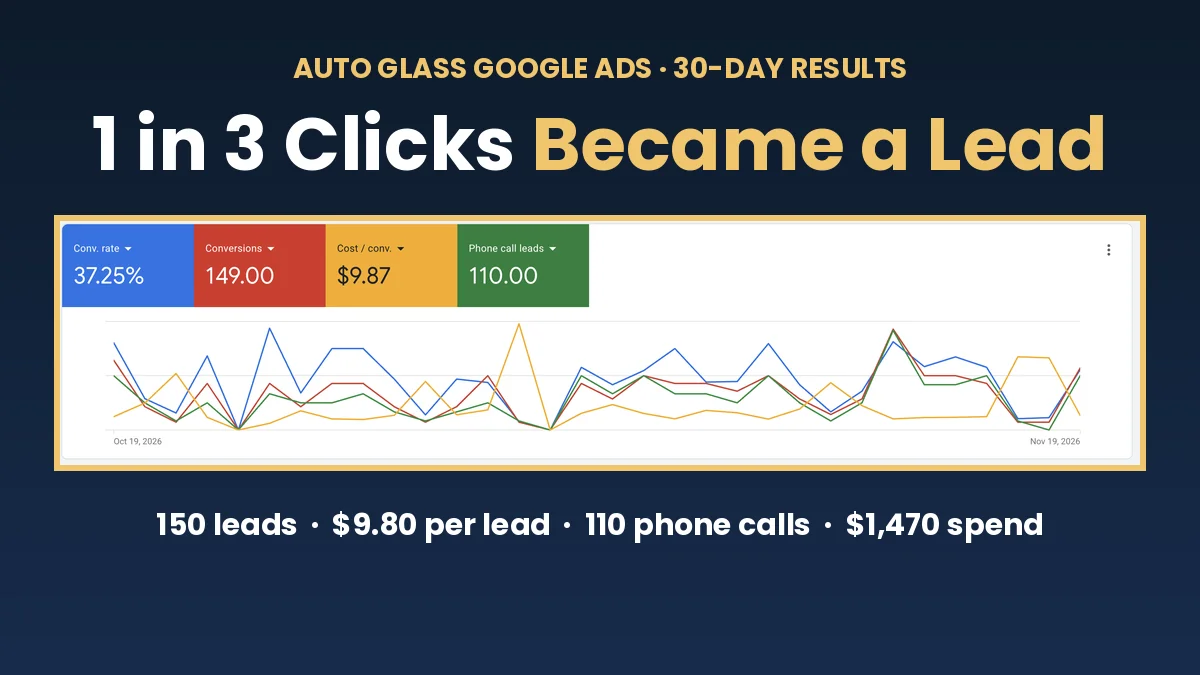
Over 30 days, more than 1 in 3 people who clicked a Pacific Northwest auto glass company’s Google Ads became a lead. The account’s conversion rate was 37.25%, which turned $1,470 in ad spend into 150 leads at $9.80 each. 110 of those leads were phone calls. The reason is simple: a highly specific campaign built around a strong offer, sending every click to a landing page made to do one thing, get the driver to call or request a quote.
This is the same client from our 157 leads in 40 days case study. That post covers the campaign structure. This one is about the number that made both results possible: the conversion rate.
The 30-day numbers
| Metric | Result (Oct 19 – Nov 19, 2026) |
|---|---|
| Total leads | 150 |
| Phone calls | 110 |
| Form fills | 40 |
| Ad spend | $1,470 |
| Cost per lead | $9.80 |
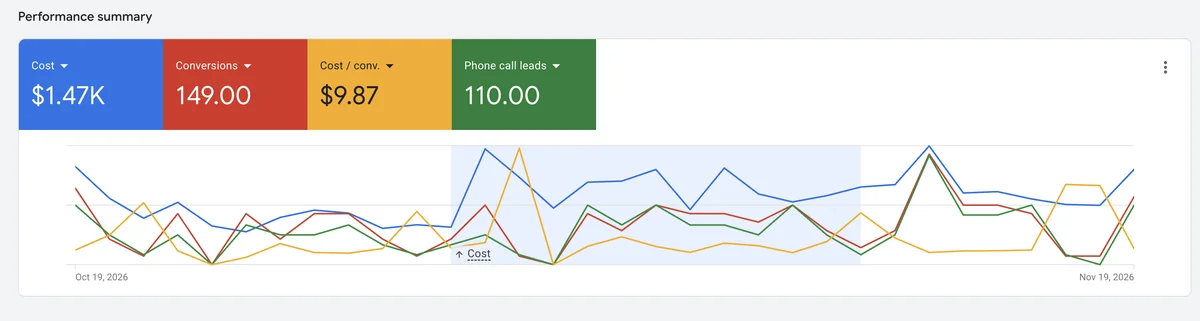
| Conversion rate (Google Ads) | 37.25% |
| Estimated booked jobs | About 90 (at a 60% booking rate) |
| Estimated cost per booked job | About $16 |
What a 37% conversion rate actually means
Conversion rate is the share of ad clicks that turn into a lead: a call or a quote request. At 37.25%, roughly 400 clicks produced about 150 leads. More than one in every three people who clicked picked up the phone or asked for a quote.
For comparison, WordStream’s 2026 Google Ads benchmarks put the average conversion rate across all industries at 8.18%. This account converted at more than four times that.
Example (not a quote)Take the same $1,470 and the same roughly 400 clicks. At an 8% conversion rate, you’d get about 32 leads at around $46 each. At 37%, you get 150 leads at $9.80. Same budget, same clicks, nearly five times the leads.
That’s why conversion rate is the most underrated number in Google Ads. Most owners try to lower their cost per click. Raising the conversion rate does far more, because every click you already pay for works harder.
Why these clicks converted
1. A highly specific campaign
The campaign is built around the exact jobs this shop wants: car window replacement, door glass, side windows and broken glass. Each has its own ads, so a driver who searches “door window replacement” sees an ad about door window replacement. Phrase and exact match keywords and a strong negative list keep out DIY, parts and home-window searches. The people who click are people who need glass replaced now.
2. A good offer
The ad and the landing page lead with one clear offer. A strong offer gives the driver a reason to call this shop instead of the next result, and it gives the ad a reason to stand out on a crowded page. When the offer in the ad matches the offer on the page, people don’t have to think. They call.
3. A landing page built for one job
Every click goes to a page built only to turn visitors into calls and quotes, not the company homepage. It has:
- A headline that matches what the driver searched
- The offer, right at the top
- A tap-to-call button that’s impossible to miss on a phone
- A short quote form: vehicle, the glass that needs replacing, contact details
- No menus, no blog, no distractions
See how to build a landing page for Google Ads.
Why 110 of 150 leads were phone calls
About three out of four leads (73%) called instead of filling out a form. That fits auto glass. A smashed window means the car isn’t secure, and people want an answer now: can you do it, when, and how much.
Google Ads counted 53 calls placed straight from the ads themselves. The rest came from drivers who tapped through to the landing page, checked the offer and then called. Both paths matter, so the account is built for calls at every step:
- Call assets on the ads, so a driver can call without clicking through
- Tap-to-call at the top of the landing page
- Call tracking on every number, so each call is tied to the campaign and keyword that produced it
- Someone answering. A call-heavy account is only as good as the person picking up the phone.
If your auto glass ads only count form fills, you’re likely missing most of your leads, and you can’t tell which keywords are actually working. See how to set up Google Ads conversion tracking.
Honest reporting, even when it’s my mistake
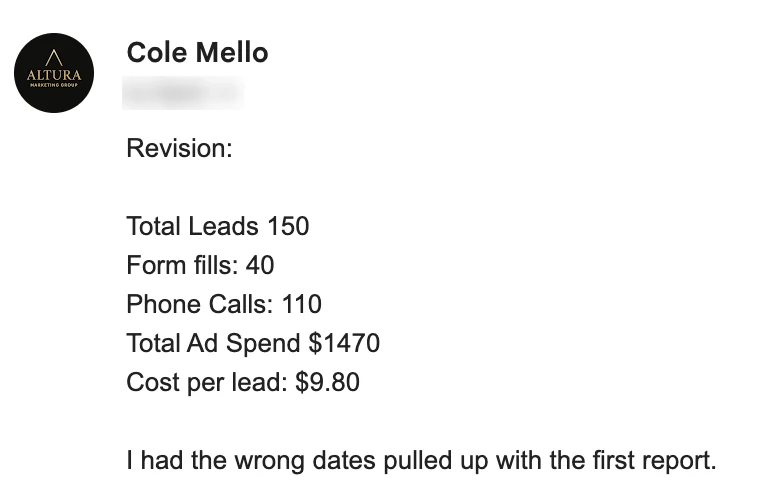
My first report for this period had the wrong dates pulled, so I sent the client a correction with the right numbers. That’s how reporting should work: real leads, real spend, the dates clearly stated, and a quick correction when something’s off. If your agency’s reports are vague or never change, ask why.
Consistent, not a one-off
In the first 40 days, this account produced 157 leads at $9.72 each. Over this 30-day stretch, it produced 150 leads at $9.80. Two periods, nearly identical cost per lead. A good setup doesn’t spike and fade. It keeps producing.
How to raise your auto glass conversion rate
- Split campaigns by service so every ad matches the search.
- Use phrase and exact match, and block DIY, parts and home-window searches.
- Lead with one clear offer in both the ad and the page.
- Send every click to a landing page, never the homepage.
- Put tap-to-call at the top and keep the form short.
- Add call assets and track every call.
- Answer the phone fast.
Frequently asked questions
What’s a good conversion rate for auto glass Google Ads?
The all-industry average is about 8%. This auto glass account converted at 37.25%. Urgent, high-intent searches plus a strong offer and landing page make rates like that possible.
Why do most auto glass leads call instead of filling out a form?
Broken glass is urgent. Drivers want to know right away if you can fix it and when. In this account, 110 of 150 leads were calls.
How much do auto glass leads cost on Google Ads?
This client paid $9.80 per lead over 30 days and $9.72 over the 40 days before. Costs vary by market and setup.
How many booked jobs came from these leads?
At the client’s roughly 60% booking rate, about 90 jobs, or around $16 in ad spend per booked job.
Want more of your clicks to turn into calls?
If you own an auto glass shop or mobile windshield business, I’ll review your Google Ads for free and show you what’s holding your conversion rate back. See Google Ads management, send a message or call 253-579-3230.

Cole Mello is the founder of Altura Marketing Group. He studied marketing at Washington State University and manages Google Ads, Local Services Ads and Meta campaigns for local service businesses. About Altura